Monday, 25 July 2022

Single-particle and collective excitations of polar water molecules confined in nano-pores within a cordierite crystal lattice

 Belyanchikov, M. A., Z. V. Bedran, M. Savinov, P. Bednyakov, P. Proschek, J. Prokleska, V. A. Abalmasov et al. "Single-particle and collective excitations of polar water molecules confined in nano-pores within a cordierite crystal lattice." Physical Chemistry Chemical Physics 24, no. 11 (2022): 6890-6904.

Abstract
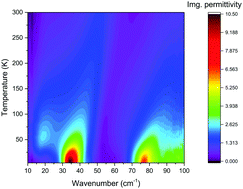
Graphical abstract: Single-particle and collective excitations of polar water molecules confined in nano-pores within a cordierite crystal lattice


Recently, the low-temperature phase of water molecules confined within nanocages formed by the crystalline lattice of water-containing cordierite crystals has been reported to comprise domains with ferroelectrically ordered dipoles within the a, b-planes which are antiferroelectrically alternating along the c-axis. In the present work, comprehensive broad-band dielectric spectroscopy is combined with specific heat studies and molecular dynamics and Monte Carlo simulations in order to investigate in more detail the collective modes and single-particle excitations of nanoconfined water molecules. From DFT-MD simulations we reconstruct the potential-energy landscape experienced by the H2O molecules. A rich set of anisotropic temperature-dependent excitations is observed in the terahertz frequency range. Their origin is associated with the complex rotational/translational vibrations of confined H2O molecules. A strongly temperature dependent relaxational excitation, observed at radio-microwave frequencies for the electric field parallel to the crystallographic a-axis, E||a is analyzed in detail. The temperature dependences of loss-peak frequency and dielectric strength of the excitation together with specific heat data confirm a ferroelectric order–disorder phase transition at T0 ≈ 3 K in the network of H2O dipoles. Additional dielectric data are also provided for polarization E||b, too. Overall, these combined experimental investigations enable detailed conclusions concerning the dynamics of the confined water molecules that develop within their microscopic energy landscapes.


for full paper see 

https://pubs.rsc.org/en/content/articlelanding/2022/cp/d1cp05338h/unauth


… For terahertz measurements, a time-domain TeraView 3000 spectrometer was employed to directly determine the spectra of the real ε' and imaginary ε" parts of the dielectric permittivity from the complex (amplitude and phase) transmission …


Tuesday, 19 July 2022

Dispersive Spectrometry At Terahertz Frequencies for Probing the Quality of NbTiN Superconducting Films

 Khudchenko, A., B. N. R. Lap, K. I. Rudakov, R. Hesper, V. P. Koshelets, P. N. Dmitriev, A. Chekushkin et al. "Dispersive Spectrometry At Terahertz Frequencies for Probing the Quality of NbTiN Superconducting Films." IEEE Transactions on Applied Superconductivity 32, no. 4 (2022): 1-6.


Abstract:

We present the quality measurements of thick (thicker than London penetration depth) NbTiN superconducting films at Terahertz frequencies using a Dispersive Fourier Transform Spectrometer (DFTS). The reflected RF signal from the tested film was measured in time domain, allowing us to separate it from other reflections. The complex conductivity of the film depends on frequency and determines the reflection coefficient. By comparing the film reflection in superconducting state (film temperature below Tc) with that of the normal state (film temperature above Tc), we characterized the film quality at terahertz frequencies, and directly probed the energy of the superconducting gap of the tested film. The experimental results were fitted using the extended Mattis-Bardeen theory and th obtained film parameters show a good agreement with the literature. In addition to the DFTS, we have also measured the properties of NbTiN film using Time Domain Spectroscopy (TDS). It is shown that both TDS and DFTS provide similar results, and both techniques can be used for the quality control of thick NbTiN films. The superconducting gap determined from the measurements by both DFTS and TDS are in good agreement for both solid and meshed films showing that there is no remarkable degradation in the film quality due to technological processes of lift-off or ion etching.

for full paper see 

Monday, 18 July 2022

Terahertz-infrared spectroscopy of wafer-scale films of single-walled carbon nanotubes treated by plasma

Zhukov, S. S., E. S. Zhukova, A. V. Melentev, B. P. Gorshunov, A. P. Tsapenko, D. S. Kopylova, and Albert G. Nasibulin. "Terahertz-infrared spectroscopy of wafer-scale films of single-walled carbon nanotubes treated by plasma." Carbon 189 (2022): 413-421.

Abstract

We investigated terahertz-infrared electrodynamic properties of wafer-scale films composed of plasma-treated single-walled carbon nanotubes (SWCNTs) and films comprising SWCNTs grown with different lengths. The spectra of complex conductance of the films were measured at frequencies 5–20 000 cm−1 and in the temperature interval 5–300 K. Terahertz spectral response of films of pristine SWCNTs is well described with the Drude conductivity model and a plasmon resonance located at ≈100 cm−1. Stepwise treatment of the films with oxygen plasma led to a gradual suppression of the Drude spectral weight from the low-frequency side. For films with the nanotubes shorter than 1 μm, i.e., close to electrons mean free path and localization length, scattering of charge carriers at the nanotubes edges is shown to additionally contribute to the carriers scattering rate and to the damping of plasmon resonance. The temperature coefficient of ac resistance (ac TCR) in both kinds of films is found to strongly increase in amplitude during cooling and frequency decrease. The values of ac TCR increase in films with longer time of plasma treatment and nanotubes with shorter length but reach saturation in films with exposure time longer than ≈100 s or composed from SWCNTs shorter than 1 μm.


for full paper see 

https://www.sciencedirect.com/science/article/abs/pii/S0008622321012355


… For terahertz and infrared experiments commercial TeraView time-domain spectrometer… complex (amplitude and phase) transmission coefficient measured with the TeraView time-domain …


Tuesday, 21 June 2022

Polymer pellet fabrication for accurate THz-TDS measurements

Murphy, Keir N., Mira Naftaly, Alison Nordon, and Daniel Markl. "Polymer pellet fabrication for accurate THz-TDS measurements." Applied Sciences 12, no. 7 (2022): 3475.

for full paper see https://www.mdpi.com/2076-3417/12/7/3475/htm

Abstract

We investigate fabrication of compacts using polytetrafluoroethylene (PTFE) and polyethylene (PE), and the effect of compaction conditions on their terahertz transmission properties. The conditions used to fabricate compressed powder samples for terahertz time-domain spectroscopy (THz-TDS) can impact the accuracy of the measurements and hence the interpretation of results. This study investigated the effect of compaction conditions on the accuracy of the THz-TDS analysis. Two polymers that are commonly used as matrix materials in terahertz spectroscopy studies were explored using a compaction simulator and a hydraulic press for sample preparation. THz-TDS was used to determine the refractive index and loss coefficient to compare the powder compacts (pellets) to the values of solid material. Sample porosity, axial relaxation and tensile strength were measured to assess the material’s suitability for terahertz spectroscopy. It was found that PTFE is the preferable material for creating THz-TDS samples due to its low porosity and high tensile strength. PE was found to show significant porosity at all compaction pressures, making it an unsuitable material for the accurate determination of optical parameters from THz-TDS spectroscopy measurements. The larger particle sizes of PE resulted in compacts that exhibited significantly lower tensile strength than those made from PTFE making handling and storage difficult.


"2.2.3. THz-TDS Measurements

THz-TDS measurements were carried out on a commercial system (TeraPulse Lx, Teraview), with a frequency () resolution of 0.04 THz. All measurements were performed in a nitrogen-purged chamber. Sample thickness (L) was measured using a micrometer () prior to the TDS measurement and was used for the calculation of the frequency-dependent refractive index  and loss coefficient ."

Monday, 20 June 2022

Detecting Crystallinity Using Terahertz Spectroscopy in 3D Printed Amorphous Solid Dispersions

Santitewagun, Supawan, Rishi Thakkar, J. Axel Zeitler, and Mohammed Maniruzzaman. "Detecting Crystallinity Using Terahertz Spectroscopy in 3D Printed Amorphous Solid Dispersions." Molecular Pharmaceutics (2022). 


for full paper see https://pubs.acs.org/doi/full/10.1021/acs.molpharmaceut.2c00163#


Abstract

Abstract Image

This study demonstrates the applicability of terahertz time-domain spectroscopy (THz-TDS) in evaluating the solid-state of the drug in selective laser sintering-based 3D printed dosage forms. Selective laser sintering is a powder bed-based 3D printing platform, which has recently demonstrated applicability in manufacturing amorphous solid dispersions (ASDs) through a layer-by-layer fusion process. When formulating ASDs, it is critical to confirm the final solid state of the drug as residual crystallinity can alter the performance of the formulation. Moreover, SLS 3D printing does not involve the mixing of the components during the process, which can lead to partially amorphous systems causing reproducibility and storage stability problems along with possibilities of unwanted polymorphism. In this study, a previously investigated SLS 3D printed ASD was characterized using THz-TDS and compared with traditionally used solid-state characterization techniques, including differential scanning calorimetry (DSC) and powder X-ray diffractometry (pXRD). THz-TDS provided deeper insights into the solid state of the dosage forms and their properties. Moreover, THz-TDS was able to detect residual crystallinity in granules prepared using twin-screw granulation for the 3D printing process, which was undetectable by the DSC and XRD. THz-TDS can prove to be a useful tool in gaining deeper insights into the solid-state properties and further aid in predicting the stability of amorphous solid dispersions.


To learn more about terahertz applications visit www.teraview.com