Friday, 12 June 2020

Optical thickness of a plant leaf measured with THz pulse echoes

Abautret, Yannick, Dominique Coquillat, Myriam Zerrad, Ryad Bendoula, Gabriel Soriano, Daphné Héran, Bruno Grèzes-Besset, Frédéric Chazallet, and Claude Amra. "Optical thickness of a plant leaf measured with THz pulse echoes." In Terahertz, RF, Millimeter, and Submillimeter-Wave Technology and Applications XIII, vol. 11279, p. 112790L. International Society for Optics and Photonics, 2020.

Abstract

We analyze Terahertz (THz) echoes by reflection on a sunflower leaf in order to evaluate the internal leaf structure (geometry, complex indices and thicknesses). The analysis is based on the thin film multilayer formalism in time and frequency domains. A high agreement is emphasized between experiment and theory, and we evaluate how realistic the multilayer solution can be in regard to our knowledge related to the sunflower leaf. A test campaign is performed in Charles Coulomb laboratory, which is equipped with the THz spectrometer.


Experimental

… 2.1 Terahertz Time Domain Spectroscopy (TTDS) In this study we performed the measurements campaign on a Terapulse 4000 spectrometer (TeraView Ltd., Cambridge, UK) with a femto-second fibre laser light source and a …


Thursday, 11 June 2020

N-glycosylation state of TRPM8 protein revealed by terahertz spectroscopy and molecular modelling

Mernea, Maria, Roxana Ulăreanu, Octavian Călboreanu, Gabriela Chiritoiu, Dana Cucu, and Dan Mihăilescu. "N-glycosylation state of TRPM8 protein revealed by terahertz spectroscopy and molecular modelling." Biochimica et Biophysica Acta (BBA)-General Subjects (2020): 129580.

Abstact

TRPM8 member of the TRP superfamily of membrane proteins participates to various cellular processes ranging from Ca2+ uptake and cold sensation to cellular proliferation and migration. TRPM8 is a large tetrameric protein with more than 70% of its residues located in the cytoplasm. TRPM8 is N-glycosylated, with a single site per subunit. This work focuses on the N-glycosylation of TRPM8 channel that was previously studied by our group in relation to proliferation and migration of tumoral cells. Here, experimental data performed with deglycosylating agents assess that the sole glycosylation site contains complex glycans with a molecular weight of 2.5 kDa. The glycosylation state of TRPM8 in cells untreated and treated with a deglycosylating agent was addressed with Terahertz (THz) spectroscopy. Results show a clear difference between cells comprising glycosylated and deglycosylated TRPM8, the first presenting an increased THz absorption. Human TRPM8 was modelled using as templates the available TRPM8 and other TRPM channels structures. Glycosylations were modelled by considering two glycan structures with molecular weight close to the experiment: shorter and branched at the first sugar unit (glc1) and longer and unbranched (glc2). Simulation of THz spectra based on the molecular dynamics of unglycosylated and the two glycosylated TRPM8 models in lipid membrane and solvation box showed that glycan structure strongly influences the THz spectrum of the channel and of other components from the simulation system. Only spectra of TRPM8 with glc1 glycans were in agreement with the experiment, leading to the validation of glc1 glycan structure.


Experimental

… corresponding enzymes. 2.3. THz spectroscopy measurements. Transmission THz time-domain spectroscopy measurements were performed using a TPS Spectra 3000 spectrometer (TeraView Limited, Cambridge). The analysed … 


Wednesday, 10 June 2020

Advanced Packaging fault isolation case studies and advancement of Electro Optical Terahertz Pulse Reflectometry (EOTPR)

EOTPR is a well-established non-destructive fault isolation tool for advanced IC devices. These examples will show how EOTPR has been implemented to investigate a wide range of advanced package types, including 2.5D and 3D packages, wafer level fanout packages, and microelectromechanical (MEMs) devices. Further, we present the recent improvements to the EOTPR instrument and the results from a novel modelling approach that has the potential of vastly speeding up the fault localisation analysis.
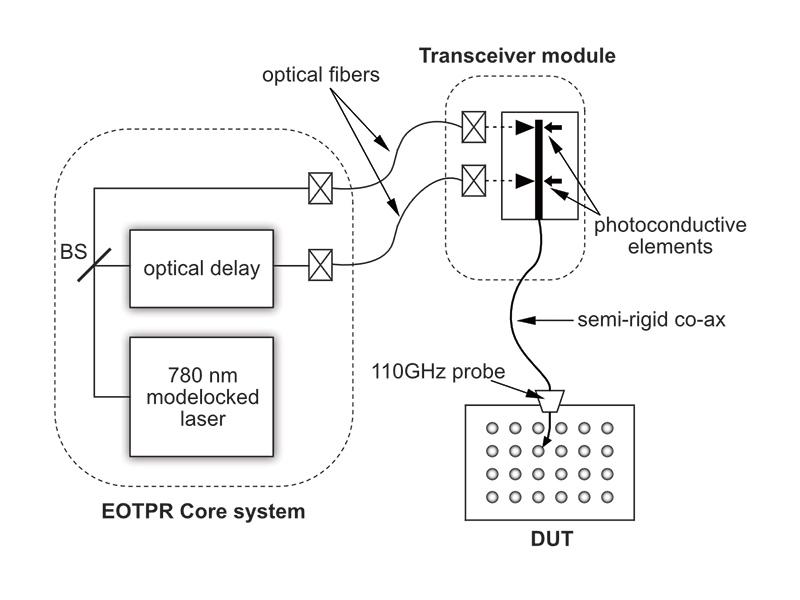
Electro-Optical Terahertz Pulse Reflectometry (EOTPR) is an implementation of the time domain reflectometry (TDR) technique at terahertz frequencies, proven to enhance fault isolation accuracy to better than 10 µm. As in conventional TDR, the fault detection accuracy of EOTPR is a function of the rise time of the incident pulse, the time-based jitter, and signal-to-noise ratio (SNR). The EOTPR instrument generates a terahertz pulse using an ultrafast laser and a pair of photoconductive switches for signal generation and detection, resulting in a system with (i) high measurement bandwidth, (ii) low time-base jitter, and (iii) a high time-base resolution.
Compared to conventional TDR, EOTPR generates signals with faster rise time, has greater SNR, and a much-reduced time base jitter; system properties that offer the potential for a significantly increased distance-to-defect accuracy.A schematic diagram of the EOTPR system is shown below.
During operation, pulses are launched into a device-under-test (DUT) via a high frequency circuit probe. Portions of the pulse are reflected as it encounters changes in impedance, such as dead opens, resistive opens, and short circuit defects, within the IC. These reflections are measured by the detector photoconductive switch and are recorded as a function of time, resulting in the EOTPR waveform. An example waveform for an open high frequency probe is shown below.
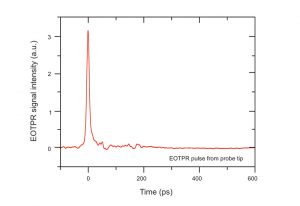
As EOTPR utilises an impulse response rather than the step response of conventional TDR, high and low impedance discontinuities in a DUT result in positive peaks and negative troughs, respectively, in the measured waveform. The magnitude of these features indicates the size of the impedance change encountered by the pulse and their arrival time gives the location of the fault. EOTPR is, by necessity, a comparative technique; to understand whether a waveform feature arises from a fault in the DUT, it is essential to compare the waveform from a known good device (KGD).
To localise a fault within the DUT the time-domain waveform can be readily converted into the distance-domain. This can be accurately achieved by measuring reference devices that have impedance features, such as opens, at known locations. The effective dielectric constant of the DUT can be determined by measuring the time required for the EOTPR signal to travel between reference features or known locations, which is then used to convert the EOTPR waveform from time to distance.
EOTPR is now a well-established technique in failure analysis workflows and has been used to interrogate a wide range of different device architectures. Examples below show how EOTPR can be used to accurately localise faults in advanced IC packages.
For more information see https://teraview.com/eotpr/

Tuesday, 9 June 2020

Broadband amplitude, frequency, and polarization splitter for terahertz frequencies using parallel-plate waveguide technology.

Hernandez-Serrano, A. I., Daniel M. Mittleman, and Emma Pickwell-MacPherson. "Broadband amplitude, frequency, and polarization splitter for terahertz frequencies using parallel-plate waveguide technology." Optics Letters 45, no. 5 (2020): 1208-1211.

In this Letter, we report a broadband frequency/polarization demultiplexer based on parallel-plate waveguides (PPWGs) for terahertz (THz) frequencies. The fabrication and experimental validation of this polarization sensitive demultiplexer is demonstrated for the range from 0.2 to 1 THz. Upgrading the demultiplexer by adding a second demultiplexer stage, a fifty-fifty amplitude splitter is also demonstrated in the same frequency range. The multiplexer is based on a stainless-steel traveling-wave antenna, exhibiting strong mechanical robustness. This unique device exhibits three splitting mechanisms in the same device: amplitude, polarization, and frequency splitting. This is a significant improvement for the next generation of THz passive components for communication purposes.


"To characterize the proposed demultiplexer, we use the Terapulse 4000 THz-TDS spectrometer from TeraView Ltd. with a spectral resolution of 4.5 GHz in the configuration shown in Fig. 2. This setup allows for the angle variation between the exit face of the demultiplexer and the receiver. An aperture size of 2.5 mm is placed in front of the receiver in order to improve the spatial resolution. In this Letter, we study two demultiplexers with two different values of the plate spacing in order to highlight the tunability of the device. In Fig. 3, the experimental results for the two demultiplexers are presented for both TE1 and TEM modes. "

Monday, 8 June 2020

Guided terahertz pulse reflectometry with double photoconductive antenna

Pan, Mingming, Quentin Cassar, Frédéric Fauquet, Georges Humbert, Patrick Mounaix, and Jean-Paul Guillet. "Guided terahertz pulse reflectometry with double photoconductive antenna." Applied optics 59, no. 6 (2020): 1641-1647.

Abstract

Developments toward the implementation of a terahertz pulse imaging system within a guided reflectometry configuration are reported. Two photoconductive antennas patterned on the same LT-GaAs active layer in association with a silica pipe hollow-core waveguide allowed us to obtain a guided optics-free imager. Besides working in a pulsed regime, the setup does not require additional optics to focus and couple the terahertz pulses into the waveguide core, simplifying the global implementation in comparison with other reported guided terahertz reflectometry systems. The system is qualified for imaging purposes by means of a 1951 USAF resolution test chart. An image resolution, after a 53 mm propagation length, by about 0.707 LP/mm over the 400–550 GHz integrated frequency band, was obtained, thus providing a promising basis to pursue efforts toward compact guided pulse imagers for sample inspection within the terahertz range.


 "By using a fiber TDS system (TPS4000, TeraView Ltd., Cambridge UK), two waveguides with different lengths (201 and 301 mm, respectively) have been characterized in transmission-mode configuration"