Friday, 5 June 2020

A Nondestructive Eggshell Thickness Measurement Technique Using Terahertz Waves

Khaliduzzaman, Alin, Keiji Konagaya, Tetsuhito Suzuki, Ayuko Kashimori, Naoshi Kondo, and Yuichi Ogawa. "A nondestructive eggshell thickness Measurement technique Using terahertz Waves." Scientific reports 10, no. 1 (2020): 1-5.


Abstract

Figure 2Eggshells play a number of important roles in the avian and reptile kingdom: protection of internal contents and as a major source of minerals for developing embryos. However, when researching these respective roles, eggshell thickness measurement remains a bottleneck due to the lack of a non-destructive measurement techniques. As a result, many avian and reptile research protocols omit consideration of eggshell thickness bias on egg or embryo growth and development. Here, we validate a non-destructive method to estimate eggshell thickness based on terahertz (THz) reflectance spectroscopy using chicken white coloured eggs. Since terahertz waves are reflected from outer air-eggshell interface, as well as the inner eggshell-membrane boundary, the resulting interference signals depend on eggshell thickness. Thus, it is possible to estimate shell thickness from the oscillation distance in frequency-domain. A linear regression-based prediction model for non-destructive eggshell thickness measurement was developed, which had a coefficient of determination (R2) of 0.93, RMSEP of 0.009, RPD of 3.45 and RER 13.67. This model can estimate eggshell thickness to a resolution of less than 10 μm. This method has the potential to expand the protocols in the field of avian and reptile research, as well as be applied to industrial grading of eggs.

"The intact eggs were measured using terahertz time-domain spectroscopy (THz-TDS, model: TPS spectra 3000, TeraView Ltd., UK) shown in Fig. 3. The eggs were irradiated by a THz pulse with an incident angle of 13 degrees. Following this, the reflected time-domain signal from the egg was obtained and reflectance calculated using a Blackman-Harris window function18. We then performed a fast Fourier transformation (FFT)."

Thursday, 4 June 2020

Contactless Terahertz Paint Thickness Measurements: specificity of aeronautics industry

Chopard, Adrien, J. Bou Sleiman, Q. Cassar, P. Fauché, J. P. Guillet, P. Mounaix, M. Pan, J. B. Perraud, and A. Susset. "Contactless Terahertz Paint Thickness Measurements: specificity of aeronautics industry." (2019).

Abstract 
We report on numerical developments for the analysis of multilayered structures and the extraction of individual layer properties obtained by terahertz time domain measurements. An iterative algorithm implements a connected propagation tree which denotes the occurrence of the incident pulse division for each reflection / transmission appearance at each interface encountered during the propagation. Each sub pulse is individually monitored and its carried proportion of the incident power is extracted. Such a process allows to obtain the specific dielectric properties of each layer but additionally permits to derive a parametric transfer function describing the whole interaction with an incident beam. Procedure results performed on aeronautics multilayered painting samples are reported. 


"The first step to achieve the simulations and the characterization, was to carefully extract the dielectric properties of each individual painting material (Tab. 1) via a basic inverse problem method thanks to measurements performed on a Teraview TPS 4000 system. Both the real and the imaginary part of the dielectric function are fitted with a first order Debye relaxation model. "

Wednesday, 3 June 2020

Low‐loss frequency selective surface for multi‐band THz transmission measurement

Yang, Xiaofan, Yonghu Zeng, Xiaoming Liu, Jun Zhou, Lu Gan, Hao Chen, and Junsheng Yu. "Low‐loss frequency selective surface for multi‐band THz transmission measurement." Microwave and Optical Technology Letters.

Abstract


Frequency selective surface is a key component in a quasi‐optical system enabling multi‐band operation. This work presents the design, fabrication and measurement of a low‐loss frequency selective surface in a quasi‐optical system for terahertz transmission measurement to separate 220 to 260 GHz and 325 to 340 GHz bands. High‐precision milling technique was employed for fabrication. The measurement was conducted using a terahertz time domain spectroscopy and a home‐made quasi‐optical test bench. Good agreement was achieved between the measured results and simulated ones. The design and measurement methods can be applied to frequency selective surfaces working in other millimeter wave bands.

Tuesday, 2 June 2020

Application of a Terahertz System Combined with an X-Shaped Metamaterial Microfluidic Cartridge

Huang, Shih-Ting, Shen-Fu Hsu, Kai-Yuan Tang, Ta-Jen Yen, and Da-Jeng Yao. "Application of a Terahertz System Combined with an X-Shaped Metamaterial Microfluidic Cartridge." Micromachines 11, no. 1 (2020): 74.

Abstract

Terahertz (THz) radiation has attracted wide attention for its ability to sense molecular structure and chemical matter because of a label-free molecular fingerprint and nondestructive properties. When it comes to molecular recognition with terahertz radiation, our attention goes first towards the absorption spectrum, which is beyond the far infrared region. To enhance the sensitivity for similar species, however, it is necessary to apply an artificially designed metamaterial sensor for detection, which confines an electromagnetic field in an extremely sub-wavelength space and hence receives an electromagnetic response through resonance. Once the resonance is caused through the interaction between the THz radiation and the metamaterial, a minute variation might be observed in the frequency domain. For a geometric structure of a metamaterial, a novel design called an X-shaped plasmonic sensor (XPS) can create a quadrupole resonance and lead to sensitivity greater than in the dipole mode. A microfluidic system is able to consume reagents in small volumes for detection, to diminish noise from the environment, and to concentrate the sample into detection spots. A microfluidic device integrated with an X-shaped plasmonic sensor might thus achieve an effective and highly sensitive detection cartridge. Our tests involved not only measurements of liquid samples, but also the performance of a dry bio-sample coated on an XPS.


"The equipment for detection using THz time-domain spectroscopy (THz-TDS) is called a TeraPulse 4000 (product of TeraView, UK). The generation of terahertz pulsed radiation is based on a photoconductive switch in which terahertz photoconductive emitters rely on the production of fewcycle terahertz pulses using a femtosecond laser to excite a biased gallium arsenide antenna. This technique is inherently broadband, with the emitted power distributed over a frequency range from 60 GHz to 4 THz (wavenumber 2–133 cm−1 ). When demonstrating the measurement, the detection cartridge is installed at the fixed sample position in the chamber, as shown in Figure 3b. After setting up, the chamber is sealed and kept filled with dry air to eliminate any influence of water vapor. The spectrum"

Monday, 1 June 2020

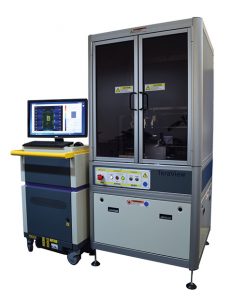
EOTPR Electro Optical Terahertz Pulse Reflectometry: The world’s fastest and most accurate fault isolation system.


The EOTPR 4000 system is configured with an automated probe station which is capable of placing the probe tip to +/- 5 μm precision, while maintaining the EOTPR’s world leading sub-5 μm fault isolation accuracy.

This combination allows users to directly probe TSV tips and copper pillars.
Key Features
  • Pre-scan station to map contact location and height.
  • Data acquisition time of less than 5 seconds per pin.
  • Software that will drive the automated probe station and pre-scan station.
  • Availability of both manual mode and automated mode for probing.
  • User interface software to manage data display and recipe creation.
  • Probe tip placement.
for more information see https://teraview.com/eotpr/#tab|1