Tuesday, 19 June 2018

Permittivity and Loss Characterization of SUEX Epoxy films for mmW and THz Applications

Sahin, Seckin, Niru K. Nahar, and Kubilay Sertel. "Permittivity and Loss Characterization of SUEX Epoxy films for mmW and THz Applications." IEEE Transactions on Terahertz Science and Technology (2018).


We present a systematic characterization of the dielectric permittivity and loss tangent of SUEX dry films for mmW and THz bands. Green and cured SUEX samples of varying thicknesses were studied using two complementary measurement techniques. First, the Nicolson-Ross-Weir technique was used in a 2-port TE10 waveguide environment for 90-140 GHz and 140- 220 GHz bands. The samples were also characterized using a transmission-mode time domain THz spectrometer over the 90 GHz-2 THz band. Real part of permittivity and loss tangent were measured to be 3.08 and 0.057, respectively for the green SUEX sample. Ultra-violet light curing reduces the permittivity and loss tangent down to 2.86 and 0.020, respectively. SUEX films can be easily laminated onto any substrate, eliminating the spin coating and long process optimizations that are required for conventional liquid resists. As such, SUEX is an easy-to-process alternative to commonly used epoxy-based resists, such as SU- 8, while exhibiting similar dielectric permittivity and material losses.


A commercial THz TDS system (TPS Spectra 3000 from TeraView, Inc.) was utilized to obtain the transmission coefficient measurements of the SUEX samples … 


Also see: teraview.com

Monday, 18 June 2018

Pilot study of freshly excised breast tissue response in the 300–600 GHz range

Cassar, Quentin, Amel Al-Ibadi, Laven Mavarani, Philipp Hillger, Janusz Grzyb, GaĆ«tan MacGrogan, Thomas Zimmer, Ullrich R. Pfeiffer, Jean-Paul Guillet, and Patrick Mounaix. "Pilot study of freshly excised breast tissue response in the 300–600 GHz range." Biomedical Optics Express 9, no. 7 (2018): 2930-2942.

Image result for Patrick Mounaix
The failure to accurately define tumor margins during breast conserving surgery (BCS) results in a 20% re-excision rate. The present paper reports the investigation to evaluate the potential of terahertz imaging for breast tissue recognition within the underexplored 300–600 GHz range. Such a frequency window matches new BiCMOS technology capabilities and thus opens up the opportunity for near-field terahertz imaging using these devices. To assess the efficacy of this frequency band, data from 16 freshly excised breast tissue samples were collected and analyzed directly after excision. Complex refractive indices have been extracted over the as-mentioned frequency band, and amplitude frequency images show some contrast between tissue types. Principal component analysis (PCA) has also been applied to the data in an attempt to automate tissue classification. Our observations suggest that the dielectric response could potentially provide contrast for breast tissue recognition within the 300–600 GHz range. These results open the way for silicon-based terahertz subwavelength near field imager design, efficient up to 600 GHz to address ex vivo lifescience applications. 


… interface delimitation tool. 2. Methods 2.1 Acquisition set-up A commercially available TeraPulse 4000 (Teraview Ltd, Cambridge, UK), with a modified reflection geometry shown in Fig. 1, was used in this study. THz pulses are … 


Also see: teraview.com

Terahertz and infrared characteristic absorption spectra of aqueous glucose and fructose solutions

Song, Chao, Wen-Hui Fan, Ling Ding, Xu Chen, Ze-You Chen, and Kai Wang. "Terahertz and infrared characteristic absorption spectra of aqueous glucose and fructose solutions." Scientific Reports 8, no. 1 (2018): 8964.

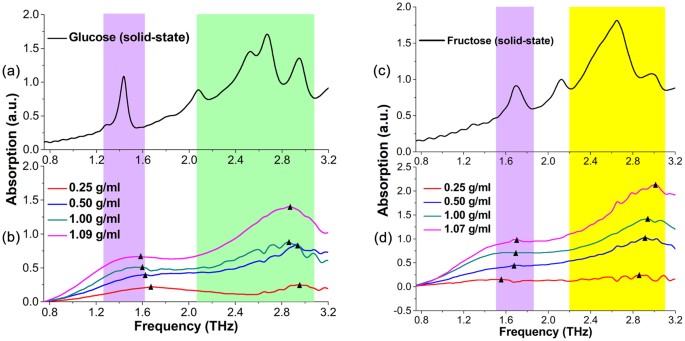
Figure 4In this paper, the terahertz (THz) and infrared (IR) characteristic absorption spectra of aqueous glucose solutions and aqueous fructose solutions with different concentrations were measured and studied. The absorption spectra of these two molecules in solid-state and in aqueous solutions were compared and analyzed, the significant effect of molecular adjacent environment on the molecular structure and vibrational mode was revealed. In addition, the THz and IR absorption spectra of these two isomers’ aqueous solutions were also compared and explored. No obvious differences were found from their IR absorption features measured at room temperature, while their THz absorption spectra do have the differences, indicating THz characteristic absorption spectra more suitable for the detection and identification of aqueous glucose and fructose solutions. The results are helpful to understand the influence of aqueous solutions environment on the molecular structures and vibrational modes of the materials, and also provide a theoretical reference for the quantum chemical calculation of biological macromolecules.


… below 1%. Experimental apparatus. The THz absorption spectra of samples were measured by using a TPS-3000 spectrometer (TeraView Ltd., UK) 22 in the range of 0.1–4.0 THz with frequency resolution of 0.03 THz. The IR.........


Also see: teraview.com

Friday, 25 May 2018

Concentration analysis of breast tissue phantoms with terahertz spectroscopy

Image result for vince wallace terahertzTruong, Bao CQ, Anthony J. Fitzgerald, Shuting Fan, and Vincent P. Wallace. "Concentration analysis of breast tissue phantoms with terahertz spectroscopy." Biomedical optics express 9, no. 3 (2018): 1334-1349.

Abstract: 

Terahertz imaging has been previously shown to be capable of distinguishing normal breast tissue from its cancerous form, indicating its applicability to breast conserving surgery. The heterogeneous composition of breast tissue is among the main challenges to progressing this potential research towards a practical application. In this paper, two concentration analysis methods are proposed for analyzing phantoms mimicking breast tissue. The dielectric properties and the double Debye parameters were used to determine the phantom composition. The first method is wholly based on the conventional effective medium theory while the second one combines this theoretical model with empirical polynomial models. Through assessing the accuracy of these methods, their potential for application to quantifying breast tissue pathology was confirmed.


The group used "All terahertz time-domain spectroscopy measurements were conducted in reflection mode using a TeraPulse4000 system (TeraView Ltd, Cambridge, UK). The system produces THz pulses with a spectral range from 0.06 to 4 THz."

Also see: teraview.com

Tuesday, 22 May 2018

Low dielectric constant composites based on B2O3 and SiO2 rich glasses, cordierite and mullite

Szwagierczak, D., B. Synkiewicz, and J. Kulawik. "Low dielectric constant composites based on B 2 O 3 and SiO 2 rich glasses, cordierite and mullite." Ceramics International(2018).


Abstract
The paper reports on sintering and dielectric properties of several glass-ceramic composites based on B2O3 and SiO2 rich glasses, cordierite and mullite. The dielectric constant values for the developed composites are low, in the range of 4.8–6.7 at 1 MHz. Some of the investigated materials exhibit low sintering temperature, suitable for LTCC (low temperature cofired ceramics) technology. A selected composite characterized by a low sintering temperature of 920 °C, low dielectric constant of 4.7 at 1 THz, thermal expansion coefficient well fitted to silicon and compatibility with commercial thick film conductive pastes was used for preparation of green tapes destined for LTCC microwave substrates.

Dielectric constant of this material was additionally determined in the range 0.15–3 THz using time domain spectroscopy (Teraview). 3. Results and discussion. Fig … 

Click for more information about TeraView